September 20, 2026 · Bryan Grubb
AI Isn't Coming for Your Job. It's Coming for Your Breaks.
Every interpreter group I'm in has had the same conversation this year. Someone posts a video of a phone translating in real time. Someone else asks if we should all start looking for new careers. Then forty comments, half panic and half denial.
I'm not going to tell you there's nothing to worry about. There is. But after digging into what's actually happening, I think most of us are afraid of the wrong thing.
Will AI replace interpreters?
Start with the numbers. In April 2025 the U.S. Bureau of Labor Statistics lowered its ten year growth projection for interpreters and translators from 3% to 2%. That's slower than average. It is not a collapse. Median pay actually went up about 5% in the same update. (Slator)
The BLS says it plainly. AI tools have made the work more efficient, but many of these jobs can't be entirely automated because computers "cannot yet produce work comparable to what human translators do." (Bureau of Labor Statistics)
Notice the word yet. I'm not going to pretend it isn't there.
Where AI is actually winning
Let's be honest about this part. Written translation has taken the hardest hit. CNN reported in January on translators watching their work dry up, one describing it as digging "your own professional grave." (CNN) Writer Brian Merchant has collected dozens of similar stories. (Blood in the Machine)
On the spoken side, the pressure shows up where the stakes are low and the budget is tight. A UN accredited interpreter told the Brussels Times she wouldn't recommend anyone in their 20s study interpreting, pointing to funding cuts and pressure to use AI to save money. In the same article, a professor who studies the field argued automated interpreting hasn't actually shrunk the human market yet. (Brussels Times)
Both of those can be true at once.
The pattern is simple. Scripted, predictable, low risk. A call to confirm an appointment time. A form. A menu. Those are the jobs at risk, and some of them are going.
The part nobody is talking about
Here's the story that stopped me.
In September 2025, one of the largest phone and video interpreting companies in the country brought in an AI system to manage its interpreter workforce. It didn't replace anyone. It scheduled them. According to reporting from Capital & Main, the time between calls dropped to as little as 15 seconds. Some interpreters report 50 calls a day. Shifts disappear with little notice. (Capital & Main)
"[The system] is supposed to optimize the perfect workload," one interpreter told them. "But you get the workload of two instead of one."
A Communications Workers of America survey of 161 of those interpreters found most reported high burnout, not enough break time, and back and neck pain. The company says the problems come from federal budget cuts and immigration policy changes, not the software.
Read that again. The interpreters still have their jobs. What they lost was the gap between calls. The breath. The minute to shake off a hard call before the next one connects.
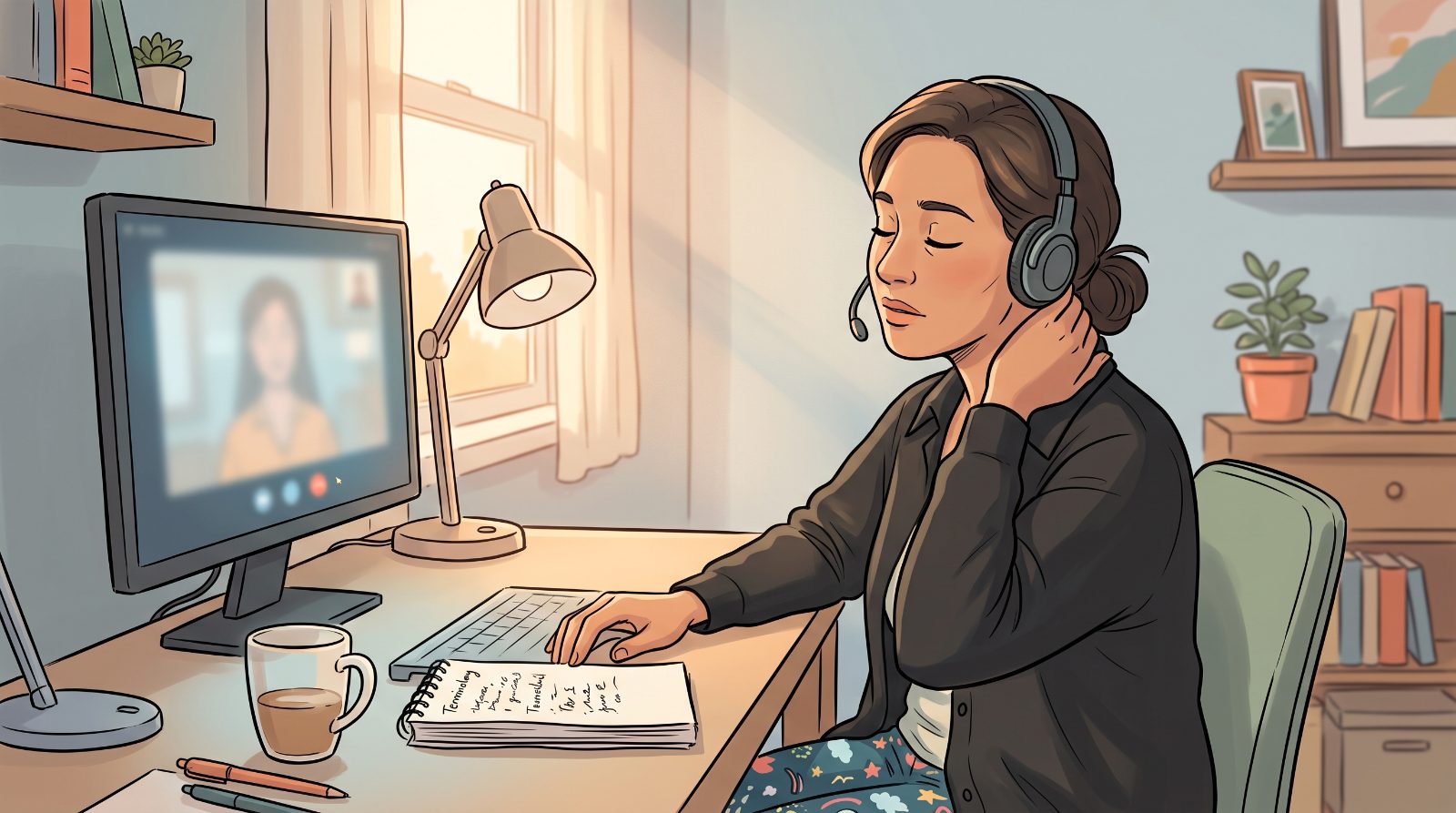
That's the threat I'd actually watch. Not a robot in your chair. An algorithm deciding how long you sit in it.
Where AI keeps falling down
The more that's at stake, the worse AI does.
In healthcare, a May 2026 paper in npj Digital Medicine found AI interpreting tools performed best in "simple, low-risk interactions" and struggled with emotionally complex conversations. It cites one study where about 5% of AI translated discharge instructions contained at least one error with potential for clinically significant or life threatening harm. (npj Digital Medicine) Several state health departments have issued guidance that machine tools may supplement qualified interpreters in high stakes encounters, but not replace them. (Your Health Magazine)
Five percent sounds small. Until it's your mother's medication instructions.
Then there's sign language, and here I'll speak as an ASL interpreter. ASL is not English on the hands. The grammar lives in the face, in space, in movement, in where you set something up and point back to it later. When China put AI signing avatars on broadcasts of the Olympics and the World Cup, Deaf viewers said they "generally couldn't understand" them, and researchers found key information was lost or distorted. (Sixth Tone)
The World Federation of the Deaf and WASLI said back in 2018 that signing avatars "do not surpass the natural quality and skill provided by appropriately trained and qualified interpreters." (WFD) The technology has improved since then, and companies are still working hard on it. The European Union of the Deaf took up the question again in a 2025 report. (EUD) The Deaf community keeps asking the right question. Who gets to decide when good enough is good enough?
The profession isn't sitting still either. The SAFE AI Task Force has released a toolkit to help hospitals, courts, and other buyers judge whether an AI interpreting tool is too risky for their setting, including a risk matrix and a push to test tools in real conditions before signing a contract. (Slator, SAFE AI Task Force)
What I plan to actually do about it
Go where the stakes are. Medical, legal, mental health, education, anything emotional, anything signed. AI's weakest ground is the work that matters most. Build your credentials and your reputation there.
Know your numbers. If you can't say what you earned last year, by agency, by setting, and per hour after drive time, you can't tell when someone is squeezing you. Those interpreters noticed because the change was sudden. Slow squeezes are harder to see.
Keep your own record. Every job. Every hour. Every mile. Every payment. Not only in the agency's system. In yours. If a platform starts deciding your workload, your record is how you prove what changed.
Learn the tools anyway. Plenty of interpreters already use AI for prep, glossaries, and terminology. Using it to prepare is not the same as being replaced by it.
Speak up about quality. When a hospital or a school considers swapping a person for an app, the people who can explain what gets lost are us, along with the Deaf and non-English-speaking communities we serve. Say it out loud.
Your record is yours
I built OneTerp because I got tired of my work living in other people's systems. Logging your jobs, your income, and your miles in OneTerp is free, and that record belongs to you. Not to the agency. Not to the vendor. Not to whatever system replaces the vendor.
It won't stop AI. Nothing I build will. But when someone tells you your workload has been "optimized," you'll have the numbers to answer them.
AI isn't coming for your job tomorrow. It might be coming for your breaks. Keep track of both.
Frequently asked questions
- Will AI replace human interpreters?
- Not across the board. The U.S. Bureau of Labor Statistics still projects slow growth for interpreters and translators, and AI performs worst in high stakes, emotional, and signed settings. Simple, scripted, low risk work is the most exposed.
- Is AI interpreting safe to use in hospitals?
- Research published in 2026 found AI interpreting tools work best in simple, low risk conversations. One study found about 5% of AI translated discharge instructions contained an error that could cause serious harm, and several states say machine tools can supplement qualified interpreters but not replace them in high stakes encounters.
- Can AI interpret American Sign Language?
- Not reliably yet. Signed languages carry grammar in facial expression, space, and movement, and Deaf viewers have reported that AI signing avatars are hard to understand. Deaf organizations continue to call for qualified human interpreters.
- How is AI affecting interpreters who still have their jobs?
- At some large language service companies, AI is being used to manage workloads rather than replace people. Reporting in 2026 described shorter gaps between calls, higher call volumes, and interpreters reporting burnout and physical strain.
- How can interpreters protect their careers from AI?
- Build skills and credentials in high stakes settings like medical, legal, and educational work, keep your own records of jobs, hours, and income, and learn to use AI for preparation. Knowing your own numbers makes it easier to spot when your workload or pay is being squeezed.